
A Tone-Deaf TikTok and the Leftist Case for Voting Kamala

There’s been quite the firestorm on my TikTok For You Page this past week over a short video posted by leftist user moschinodorito. In the video, he references the police killing of Sonya Massey to mock liberal support of Kamala Harris. The response has been largely, and often viscerally, negative. I’ve watched several Black TikTok users stitch his video with responses mostly focusing on his insensitivity, using Massey’s killing (but not her name) to make a smarmy point about liberals and the upcoming presidential election. He’s been accused of being racist, using Black people as “pawns” in his own approach and outlook regarding politics. Some have cast him as a stand-in for cishet white male leftists in general, guilty of worshipping and reciting theory in place of organizing or other forms of direct action. His video has basically triggered a wave of grievances that I have to admit surprised me in a couple ways.

My initial reaction to his video was nonchalance, to be totally honest. While lazy, crude, and dark, I immediately understood the ironic and frustrating juxtaposition he was pointing out: while witnessing yet another innocent Black American slaughtered by an unhinged white police officer, we’re still awash with enthusiastic Democratic endorsements of a former prosecutor for the party’s presidential nomination after Joe Biden announced he is ending his reelection campaign. But the negative reactions, particularly those of Black users sharing their thoughts, forced me to sit with some discomfort, because my impulse upon initially seeing these responses was to defend him.

As a white male leftist myself, I probably have to admit to some internal bias here. I loathe the thought that I may contain these blind spots, these impulses and reactions that are functionally inconsiderate of the very marginalized populations my ideology is meant to protect and support. I thought, “How could he be out of line here? He’s outraged by racist police violence! He’s mocking the cruel and twisted system that perpetuates all this suffering!” But I quickly came to understand I was missing the point. His oversimplification of the situation, and for that matter, his attempt to try and draw a direct connection between Massey’s killing and Harris’ candidacy, was paternalistic and insensitive. It was a cheap attempt to feel superior and incisive.

As much as my feeling on his video has changed, there are still some frustrations I have about some of the criticism he’s receiving. But I don’t want to get any more bogged down in the discourse over this video itself. In at least one vital way, it’s not really my place to die on a hill defending a misguided attempt at satirizing racial violence against a minority group to which I do not belong, lest I run afoul of the same sort of mistake he made, regardless of my good intentions. What has really stuck with me about this was a somewhat tangential discourse about voting in general elections, and what that does or does not mean.

____________________________________________

Like most leftist-inclined people I encounter online, I have immense contempt for Democratic party leadership. Their complicity in many of the most pressing sociopolitical disasters – imperialism, economic austerity, the war on drugs, the carceral state, insufficient action on climate change, and support for the Israeli government’s depravity, to name a few – is beyond any serious question in my opinion. One natural outcome of this is the disgust this engenders in left-wing voters when liberals and Democratic officials insist that we keep checking the box next to whichever candidates are thrust forth with a “D” next to their name. To “Vote Blue No Matter Who.” We’re simultaneously condescended to for our alleged “purity politics” and ignored on nearly all matters of policy, particularly anything that would be a break with the way the government has operated after the instruments of The New Deal were steadily left to die or outright killed by Democrats and Republicans alike. I could go on regarding this matter of The Discourse, but it would quickly turn redundant and a bit whiny. Suffice it to say, there’s plenty of reason for any leftist to feel frustrated and exhausted by the Democratic establishment and the resulting liberal rhetoric.

All these valid and real frustrations aside, I believe there is still a strong case to be made that voting for Kamala Harris – or probably any Democratic candidate that could potentially arise following the DNC next month – in the 2024 presidential election is the most appropriate choice for a sincere leftist this November. The ultimate reason is one I assume any reader would be familiar with: defeating Donald Trump and a Republican presidential attempt to implement the actions proposed in The Heritage Foundation’s Project 2025. But I don’t want to focus entirely on that reason. Rather, with the amount of left-wing avowal to either abstain or vote third-party, I want to build the case for voting Kamala as a small but significant action of left-wing values itself.

____________________________________________

As someone who was resistant to voting for Joe Biden this November myself, I know what it’s like to hear this frustrating appeal to harm reduction. And while it is a relief to see Biden’s particularly abhorrent personal commitment to Zionism off the ticket, I fully understand that Kamala Harris and her yet-to-be-named running mate are unlikely to break in any meaningful way from supporting the Israeli government’s bloodthirst. And make no mistake, that is the issue at the moment driving most left-wing refusal to vote for a Democrat in this general election: Israel’s staggering escalation of the Palestinian genocide. Yes, the Democratic establishment has failed on many other urgent issues – insufficient mitigation of climate change, no meaningful police reform, the War on Drugs and mass incarceration, dismal healthcare policy, capitulation to Wall Street, to name a few – but the slaughter of Palestinians with the material and political support of our federal government has justifiably sickened anyone with a conscience. And from my own feelings and those I’ve heard expressed from many other people on social media, it’s that matter of conscience that leaves people disgusted with the notion of voting for Harris – particularly the feeling of support of or complicity in the genocide that we may attach to the act of voting for her.

But the discussion surrounding moschinodorito’s video has really led me to not just reconsider this framing of what it personally means to vote for a particular candidate, but also the role of voting in the greater context of political action at this moment in American history.

____________________________________________

First, the matter of personal conscience in selecting a candidate. In a culture that has instilled within us a strong focus on individualism and personal responsibility, but also a political system that has disenfranchised and disempowered us in countless ways, we’re left in a cruelly disorienting position. For those of us with a strong sense of indignation at systemic injustice and the accompanying alienation it has engendered, we naturally crave any little way we can think to push back and enact whatever power we can muster. And that, I believe, is an origin of this fervent sense we have to directly associate our vote with a deep, personal reflection of our values. We’re so disenfranchised and disconnected from power that we place outsized influence on the one small act that is left to us (mostly) without resistance from the institutions of power. Couple this with the often-nauseating liberal fetishization of voting and their bad-faith condescension toward any left-leaning people that dare refuse to unenthusiastically play along, and we have spite in the mix. Thus, the notion of voting third party or just skipping that section of the ballot altogether is a way we can attempt to feel good and righteous in contrast to the vocal supporters of a party we know has routinely failed us. It allows us to view this as a staunch refusal to participate in the various and sundry miseries our elected (and unelected) leaders inflict upon the world. And I believe we’re mistaken in this sort of thinking. If I’m truly honest with myself, I have to admit it’s fair to even consider it selfish. It’s an understandable, but effectively destructive impulse to elevate our personal feelings above the increased harm that I think any honest leftist knows would come with a second Trump term.

And so, I think we can just unclench and let go of all this pressure, for lack of a better word, and be realistic about this election. The only meaningful thing we can achieve with this election is the defeat of Donald Trump, but that does have enough meaning to warrant all this bluster. With neither candidate willing to oppose Israel and cut off the supply of weapons and political cover, the plight of Palestine is off the table for us at the voting booth this November. There is nothing we can do, no box that we can check that will do a fucking thing to change it electorally. It’s disgusting, infuriating, and devastating that we’re in this position. But it’s not our fault. We need not place that burden upon ourselves as general election voters. The protests, BDS, other pressure campaigns, and all other direct action available to us is where that fight has to take place at the moment. ____________________________________________

The second thing I wanted to touch on regarding this issue is the significance of voting itself in the larger process of sociopolitical change. I admittedly have less to say about this because I am not well-versed in the theory or practice of organizing and direct action, but it’s still worth mentioning because I often see this topic mentioned by leftists as a contrast to electoralism. And despite my lack of deep study on the matter, I’ve listened to and read enough discussion on the matter to acknowledge that electoralism, at least in its current form in the United States, is not a key driver for progress as we would define it. In fact, I think it would be absurd to deny it. And my point here is that electoralism’s very nature as a futile method of revolution is another reason leftists should consider dropping their strong opposition to participating in it on its own, limited terms.

So, why should we still allow ourselves to be so worked up about it? We need not fully remove ourselves from the equation just because of voting’s limitations. We need not overreact to liberals’ obnoxious and ignorant tendency to reduce the entire political process to voting every two years and treat everyone to their left like children. It can be such a misuse of energy to allow these frustrations to drive us away from the very narrow but crucial act of opposing Trump and the Republicans Party’s national project. Voting Harris is just a one-day side-quest that can mean so much to women, our LGBTQ+ neighbors, and the newly revived labor movement.

____________________________________________

Voting for Kamala Harris is not an implicit endorsement of her or the Democratic Party. It is not moral or spiritual support of Israel’s genocide, and it does not reflect on any of us. It is purely a small act of opposition to the specter of a second Trump administration. And to damn them with such faint and pitiful praise, it can be a wrench thrown into the gears of so many horrible machinations that the Democratic party is less eagerly committed to visiting upon us compared to the increasingly ravenous GOP. Because regardless of what we do in November, or who wins, we’re still left with the same responsibility to each other and our world every day moving forward. We’re still faced with the overwhelming cruelty that the corporate, imperial juggernaut that is Washington inflicts upon humanity every day. Grim as it feels, casting your vote for the Democratic candidate is a meaningful and direct opposition to Trump. And if that can, even in a small way, lessen the difficulty of our struggle against our oppressors, then I think it’s fully consistent with our leftist values to do so.
We Know You Know Better

Online Libs are addicted to pointing out the right’s hypocrisy. They love it to death. Sure, it’s often warranted and satisfying, but it’s ultimately pointless and played out. Plenty of progressives, leftists, and media critics have caught onto this game and have offered a range of insight into the impotent, masturbatory, but most importantly, misguided nature of it. It’s a worthy topic for thought, especially if you’re the type, for example, to think you’ve “destroyed” some evangelical bigot by telling him he isn’t Christ-like. Trust me, he knows. And he’ll have an asinine retort or scripture passage to respond with, and he doesn’t care anyway. That’s the point. He’s not playing the same game you are.

This post isn’t mean to dive into that idea. It’s already been tackled by people much more talented and thorough than I am. But the semi-recent and massive increase anti-trans hysteria, accompanied by a growing wave of restrictive and brutal bills in state houses throughout the country, has gotten me thinking about a tangential aspect of The Discourse: most of the Online Right aren’t just hypocritical in their views and eager to deploy an array of absurd lies to support them. Rather, they’re simply lying when they tell you what they think and believe. And to varying degrees, I think most know it themselves.

To get something out of the way, I like to think it’s obvious I’m not talking about the rare few who openly admit to their bigotries or “-isms” of choice, as heinous and jarring as they might be. Most people across the ideological spectrum like to think they’re the Good Guys, or at the very least, will attempt to convince others of this conviction. One would reasonably think it should be easy to default to some sort of fundamental values or ideological framework when defending a belief or statement from criticism. These are the reactionaries I am talking about, and this is where they run into trouble, when they cannot honestly counter any good-faith critique. To use transgender rights as an example, I would simply and honestly state that someone’s personal and intimate experience should respected without interference from the state when it comes to the care they need to live their preferred gender expression. But even though they believe the opposite, you are unlikely to see a right winger explicitly state it as such – that they do believe it is critical for government to intervene in such personal matters in order to maintain a direct sex and gender binary in its citizens. So, they have to frame it differently to hide that fundamental belief.

Regardless of whether they’re aware of the internal hypocrisy, they know it sounds bad. There’s no escaping the implication of these beliefs, as evidenced by the actual content of the bills being proposed and passed. Thus, the belief has to be masked by concern-trolling language, laundered through faux compassion for children or women. Perhaps even the old “just asking questions” gambit. This just kicks the can down the street a little: why assume kids cannot understand the basics of gender expression? Why the leap to the conclusion that LGBT+ education/exposure is grooming? Why paint all of cis womanhood as threatened by or opposed to transgender people? This is all just more ugliness, often being passed off as “concern” of some sort, and to engage with it is to become mired down in a debate that allows bigots to claim some level of legitimacy and prudence. Essentially, they could argue that the very existence of this heated discussion is reason enough to warrant respect for their views as something that isn’t just simple prejudice or outright hatred. But it’s not an honest discussion on the matter: it’s a fight started and fueled by people who deny others’ humanity. It’s not a reasonable discussion on a matter, such as education policy around gender expression, or more banal details around how transgender rights could be outlined. It truly does boil down to a fight over the right for certain, innocent people to simply exist as they wish. And the people who oppose them know this, despite whatever watered down rhetoric or outright obfuscation they deploy.

My focus on transphobia is the result of the current moment, but this brand of dishonest sadism-masquerading-as-concern is prevalent. A few years ago there was a frenzy over the pressure to remove public monuments of Confederate officials and military figures. The conservative pushback included fears of “erasing history,” as if these statues were crucial to education and knowledge to begin with. The lie had to be deployed to cover for the obviously icky alternative of having to admit appreciation for the Confederacy’s pro-slavery enemies, or at the very least functioned as a lazy attempt to avoid the essentially impossible task of defending the purpose and value of such public monuments. Thus, “you can’t erase history” is “the Confederacy wasn’t bad (enough).”

The anti-abortion (“pro-life”) movement is another fascinating example. While there is room for some more nuance here, particularly for the seemingly rare true-believers whose activism is displayed as near universal compassion extending well beyond the issue of abortion, much of the movement’s reasoning can be translated to its true, dishonest meaning and dismissed accordingly. Skipping past some obvious surface level hypocrisies – violent rhetoric, frequent support for the death penalty, and near total cultural overlap with support for war and imperialism – their lies are exposed when they reflexively oppose essentially every policy or personal practice proposed in the name of reducing the frequency of unwanted pregnancies. Universal healthcare/childcare, wealth redistribution, the morning after pill, birth control/condoms, public housing, and social spending in general, all of which comprise a very literal pro-life ideology, are pooh-poohed to varying degrees by the majority of the anti-abortion movement. Some states’ anti-abortion laws are even restrictive of abortive procedures that are functionally life-saving interventions for the mothers, or grief-reducing for expectant parents when the fetus is known to be unviable. But, because “nobody is allowed to do this because my religion (supposedly) forbids it” is such a weak and obviously unjust line of reasoning, abortion opponents have to label both their philosophy “pro-life” and the practice itself as “killing babies” to sell it.

One could spend a lifetime discussing the range of issues the conservative worldview softens and legitimizes through this bad faith style of expression. The rapacious and vulgar conquest of other lands is cleaned up as “spreading democracy and fighting terror.” Brutalizing and displacing the already-immiserated unhoused population is just “cleaning up the streets.” Turning a blind eye (or even openly supporting) appalling police misconduct sounds better as “back the blue.” Just a few moments’ honest inspection on nearly every hot button issue yields fascinating and revealing beliefs and behaviors. We could do this all day.

As I alluded to earlier, all of this is done not only to clean up and give legitimacy to flagrantly undignified beliefs, it’s also a stubborn and lazy way to effectively shut down all room for nuance on a given topic. Yes, the space for discussion and debate on matters will always be open, but this type of exaggeration and lying can often force entire discussions into idiotic and unnecessary binaries. There is no room left for the nuances, imperfections, and natural difficulties and imperfections inherent in the debate over any policies relevant to so-called “hot button” issues. In fact, conservatives will often only acknowledge or cite the imperfections of left-minded policies in service of their own preferred policies, even when the negative outcomes of right-wing policy are far worse by any relevant measure. To use the topic of transgender medical care again, stories of people de-transitioning or regretting gender-affirming surgery are a go-to cudgel for the “gender critical” crowd, cited with a straight face in comparison to the much larger number of people who transitioned without regret and lived much more happily as a direct result. If they truly cared for those unfortunate few gender dysphoria patients with heartbreaking regret, the focus would be on the care these people need instead of the transgender community at large, against whom these stories are deployed with cynicism and contempt.

In my view, what this all means is that leftist/progressive/liberal minded people ought to focus less on the easy “gotcha” of pointing out hypocrisy, instead pointedly identifying the true beliefs underlying the more odious and damaging lines of conservative discourse. Hypocrisy is ultimately just a rhetorical concept, an interesting and narrowly useful one that should take a back seat to the material relevance of the issues and policies we argue about. Perhaps we should seek for ways to engage with argumentative conservatives, civilly and in good faith, on this basis. It’s already uncomfortable (for most of us) to argue and debate many of these things with people we find difficult, who say things we find distasteful and even abhorrent. So why not take the effort to make these moments more meaningful and refuse to let conservative opponents off the hook? Instead, focus on what they are really saying. Make sure they know that we know what they’re saying. Maybe they’ll finally be faced with the choice to truly defend their beliefs on their own merits, or come to terms with and finally begin to turn away from the inherent ugliness of their views.

Facts, Feelings, & The Worst Tweet of 2019

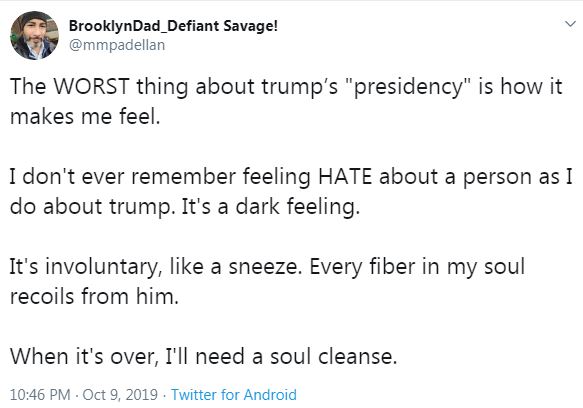
I know a lot of us really enjoy ourselves some hyperbole, and that Twitter discourse does not smoothly align with what happens in real-life. But I quickly developed a sense of having stumbled upon something definitive and decisive about Trump-era liberalism when I saw the following tweet:

Worst Tweet 20191010

It’s difficult to begin to fully describe everything maddening and pathetic about that statement, but since this is a blog post about it, I’m gonna try.

This tweet is like a fully evolved iteration of the feckless “If Hillary Won, We’d Be At Brunch Right Now” signs that have appeared at various marches since 2017.  It’s a sort of culmination of the #Resistance™ that began in earnest following the 2016 presidential election, the groundwork having been laid by prominent liberal political and media figures who essentially anointed themselves leaders of a movement to defy the oncoming storm of a Trump Administration. And while it’s an absolute necessity to generate massive resistance to the grotesque nature of Trump’s agenda, the mainstream liberal face of the movement was lacking in substance and value from the very start. To put it most succinctly, they took Trump’s election personally and never expanded the reaction much beyond this feeling of being inconvenienced and generally upset.

Conservative pundit Ben Shapiro, an intellectual fraud inexplicably respected among the online-right, has long had a fondness for “owning the libs” with the catchphrase “facts don’t care about your feelings.” He and many like him just love to label anyone expressing compassion as a bleeding-heart snowflake, too prone to fits of emotion in the face of the muscle-flexing juggernaut that is Logic. But rather than serving as a general axiom for navigating the difficulties of everyday life, conservatives of Shapiro’s ilk just use “facts don’t care about your feelings” as a double-ended bludgeon: to claim that factual reality necessitates conservative policy and that human emotion is a sign of flaws and weakness. It doesn’t much matter what the topic at hand is, conservatives will shoehorn the facts-versus-feelings dynamic in wherever it suits their ideology. Does a relatively small number of mega-wealthy elites exert too much power and drive catastrophic income inequality? Too bad, they earned their position in the world and you’re a pussy for crying about it. Are you concerned about the US government’s violent, cruel, and careless foreign policy? Tough luck, we’re fighting for freedom and civilian casualties are just the cost of doing business in a world of good versus evil. This exercise could drag on considerably, but the key flaw in this Facts & Logic fetishism is that the right often relies on premises that are far from factual, often open for debate, and sometimes even foundationally bullshit. What this approach typically represents is them claiming the Land of Logic in the name of the right and then reverse-engineering their own preset feelings into what they conveniently consider to be the facts that support them.

None of this is to say that facts have no place in a world that should be dominated by feelings. I go to a weekly support group modeled after Recovery International, a self-help mental health organization founded by neuropsychiatrist Dr. Abraham Low in 1937. Among the many tools and guides in the program is the phrase “feelings are not facts.” At first glance this seems uncomfortably similar to Ben Shapiro’s guiding principle. But rather than functioning as a weaponized statement, “feelings are not facts” is intended to calm and empower people who struggle with a variety of mental and emotional struggles. Just because you feel worthless or hopeless or doomed doesn’t make it true. If you avoid social situations for fear of judgment or humiliation, it would help to know it is by no means a fact that everyone is closely watching you and waiting for an opportunity to criticize you. That odd or uncomfortable physical symptom you may be experiencing, or disturbing mental state does not automatically mean you are dying of some awful disease or losing your mind. This is the uplifting perspective on the facts versus feelings dynamic, the use of rational thought to ease tension instead of attempting to deflect all criticism and reframe it as emotional immaturity.

Maybe this all sounds like a “both sides!” detour from the subject, but almost immediately upon reading this tweet I got a sense of a real snag in this user’s facts and feelings priorities. I don’t dismiss the seething hatred this man feels. I cannot begin to recall all the times I’ve caught myself pacing around angrily in my house, ruminating on some new horror the Trump administration has brought into being. I agree that it’s miserable to feel this way, however naturally it may come. But I’m more interested in what informs such feelings and how they are expressed. What is the primary issue? Is it the dark, helpless negativity you feel? Are you the victim here, BrooklynDad? And “when it’s over” will equilibrium be reestablished by your “soul cleanse?” Is the Trump presidency an aberration bookmarked by eras of happy normalcy?

It may seem petty and nit-picky but this brand of faux-liberal, centrist narcissism consistently seems to ignore the primary victims not only of Trump’s policies but of American policy in general. A lot of us are profoundly upset and disturbed by this administration’s actions, from the separation of immigrant families, the imprisonment of children in literal concentration camps, complete disregard for catastrophic climate change, continued reckless use of military terror abroad, racism, sexism, assault on LGTBQ rights, disgraceful tax policies, and the constant, full-throated, pathetic stream of lies. I think some of those could vie for the honor of “WORST thing” of Trump’s presidency. And they qualify for that distinction not because of how they make me, or anyone else, feel, but because they are de facto morally repugnant and cause grave material harm to broad swaths of people. To varying degrees, his ideology and behaviors are bad purely because they drive death, destruction and decay. And even though Feeling Bad is the natural response to such matters, that bad feeling is a side-effect, a reaction.

Ideally, I believe a person’s values will drive their emotional reactions to the reality (facts) they encounter or experience. And the behaviors driven by those emotional reactions are, in my opinion, most revealing of a person’s values. Are you going to go on social media to post emotional screeds about how the president hurts your feelings, or are you going to center the primary victims of his policies when you discuss him? Are you going to engage the moral roots of destructive policy or are you going to find a way to twist it into a cathartic “YAAAS KWEEN” viral tweet to get Likes and Retweets from legions of wine moms and #StillWithHer drones? To put it in the clearest terms, when you criticize and excoriate the Trump (or any powerful figure), are you centering his victims or are you putting yourself on the cross?

I don’t mean to portray Twitter discourse as the crucial foundation of social struggle. I am fully aware that most of us Online People are little more than keyboard jockeys duking it out with varying levels of elevated self-importance. And while there is no substitute for protests, demonstrations, and other forms of direct action, I do believe that the way we communicate and express ourselves in all forums and mediums does carry some importance. I think it’s a safe assumption that aside from voting, for most of us our primary political engagement (in the US, at least) comes in the form of social media participation and consumption. And while that may not seem significant taken at face value, the ideas communicated and absorbed can have a significant influence when spread among enough minds over time. And as those things evolve and disperse, so do the minds of all of us engaged in it, which can create an atmosphere of more significant and substantial resistance, inspire more direct action, and strengthen the resolve of The People to demand the justice and respect we all deserve. So try not to focus on feeling bad for yourself. Take the next step and let yourself be an ally for those directly targeted and harmed. On large enough scale, it can foster the solidarity we need to counter our oppressors in ways they cannot stave off.